Why Lining Things Up Calms You Down
Published Nov 5, 2026 · ~6 min read
A grid of colours, one swap, and three matching pieces vanish; everything above slides down and the board settles into a new shape. Nothing worth reporting happens, yet plenty of people watch it for a long while and come away genuinely looser. What tidiness actually does to a tired head is worth spelling out.
The first swap barely needs thinking
The colours are already laid out in front of you. Your eye sweeps across, spots a row with two of a kind next to each other, or a gap that is one piece away from a match, and your hand is already there. That kind of judgement runs on visual search — it looks for overlap in colour and shape rather than meaning, so nothing has to be read out or put into words.
That matters more than it sounds. After a long meeting, or after explaining something to someone at length, the tired part of your head is the language part. Ask it to read a paragraph or follow an argument and it costs extra; matching colours goes around that block, which is why you can still play smoothly when you have no appetite for talking.
Tidiness is predictability
The grid starts messy: colours interleaved, positions without a pattern, no way to know what will appear next. Once you swap a pair and a line clears, the pieces above fall into places you can work out in advance.
Uncertain things have to be watched continuously; certain things do not. When the board shifts from "anything could be here" to "I know what happens next", there is less to monitor and attention drops a gear. Straightening a desk, squaring the edges of a stack of paper, winding a loose cable back onto its spool — the comfort in all of them is the same thing. A sense of order is not really an aesthetic taste; it is the question "what happens next" getting an answer.
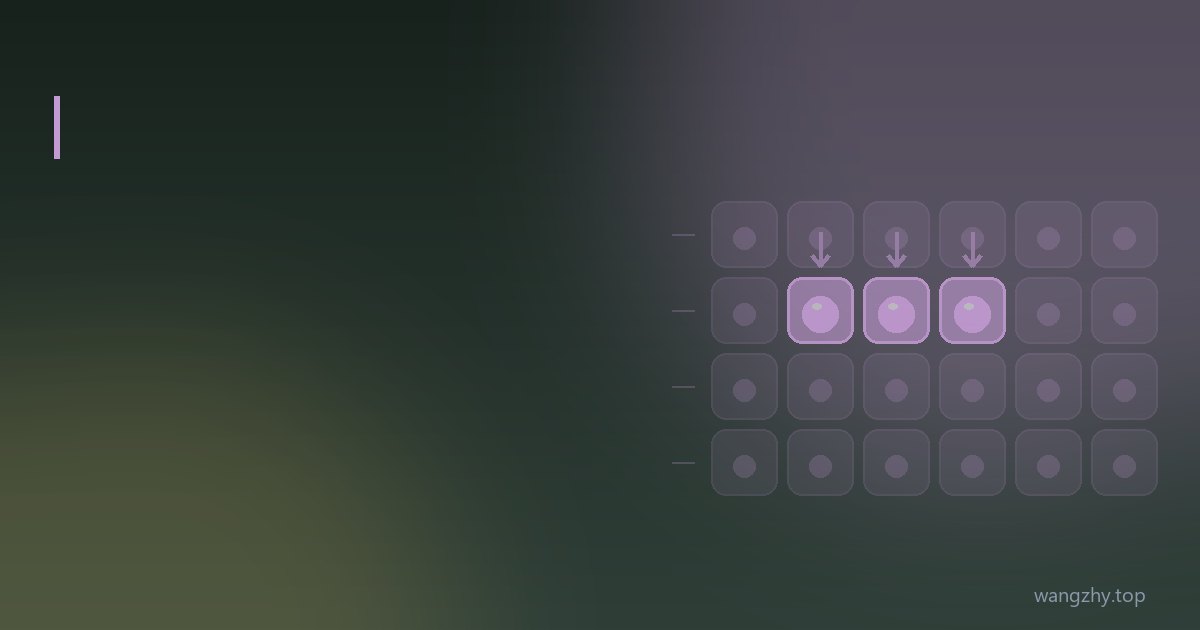
That click is completion, not pleasure
The best moment is not the score popping up. It is the three pieces disappearing together and the hole being filled from above. Gestalt psychology calls the reaction closure: a shape with a piece missing is faintly uncomfortable to look at until the piece is put back.
The Zeigarnik effect adds a little more weight — unfinished things occupy space in your head and only step aside once they are done. The trick of a match-3 is that its completions are tiny and frequent: a dozen of them a minute. Real work often closes once every few months, sitting there in the meantime, taking up room without leaving.
One rule, so it costs no headroom
A pair-matching game still asks whether two tiles can be joined and with how many turns. A match-3 asks one question: same colour? With fewer rules you are not holding a rulebook in mind while your hand works, so attention can sit entirely on the board.
That is also why it is easier to relax into than many leisure games that look more elaborate. More rules means a slower way in, and while you play you are carrying several things at once. Match-3 has no entry cost — open it after six months and there is nothing to relearn. For "I want to unwind for three minutes between tasks", how fast you get in matters far more than how deep it goes.
How it keeps you there
Honesty is needed here: what keeps people on these games has little to do with comfort. Whether a clear triggers a chain, whether it takes out an extra group, is random — and random rewards are the hardest to walk away from. Behavioural psychology calls it variable-ratio reinforcement; slot machines run on the same schedule.
So when the thought "just one more, let's see what it scores" shows up, you are no longer resting. The difference is concrete: rest means that after this round you are looser and can stand up; chasing score means the instant the round ends you want the next one, while the thing you were doing is still waiting.
The jelly match on this site has no levels and saves no progress — one round, then a result screen. The board keeps a single-round score, one entry per device, and has no ranks or seasons. Not out of purity: add any of those and the game stops being a way to loosen up and starts being something you owe your own record.
Getting three minutes' worth
Decide up front how this round ends: when there are no moves left, or when the score appears, you get up. Do not say "one more round" — that sentence has no endpoint, and saying it hands the stopping time to your future self.
Put down what you were doing first. Playing while waiting for a reply keeps half your attention on the message: absent-minded play, and neither side gets a rest. It is the same attention residue problem — switching itself costs energy.
Same rule for your eyes: a round or two, then look at something six metres away for twenty seconds. The sweets are high-saturation, and after ten minutes of staring your eyes will feel dry — that is not mood, it is simply your blink rate falling.
If what you want today is "think about nothing at all", something that needs no screen works better, such as slow breathing. If you want your hands busy, bubble wrap does about the same job, only shorter and with nothing to watch.
Frequently asked questions
I just want the grid tidy — is that OCD?
No. The key feature of OCD is that not doing it feels unbearable, it has to be repeated, and it clearly interferes with daily life. Here you play when you feel like it and stop when you are done, and nothing else gets neglected. The real difference is control: one is you choosing, the other is you being pushed.
Why does my head go so quiet while playing a match-3?
Because there is only one rule — same colour? — and the judgement runs entirely through the visual channel without using the language one. After a meeting, or after explaining something at length, the language area is exactly what is worn out. Route around it and attention settles on the board; the sentences looping in your head suddenly have nowhere to be used, so they quiet down.
Half an hour disappears — am I hooked?
Look at the moment you stop. If you finish a round and get up, that is rest. If you keep thinking "one more" and cannot stop when you meant to, that is worth noticing. Naming the end condition in advance — stop when there are no moves — works far better than relying on willpower in the moment.
Is this hard on the eyes?
The strain comes from screen time and a falling blink rate, not from the colours themselves. Keep rounds to two or three minutes and look at something six metres away for twenty seconds afterwards. If your eyes feel dry or tight, stop rather than pushing on.