Why a Little Difficulty Helps: The Right-Sized Challenge
Published November 2, 2026 · ~6 min read
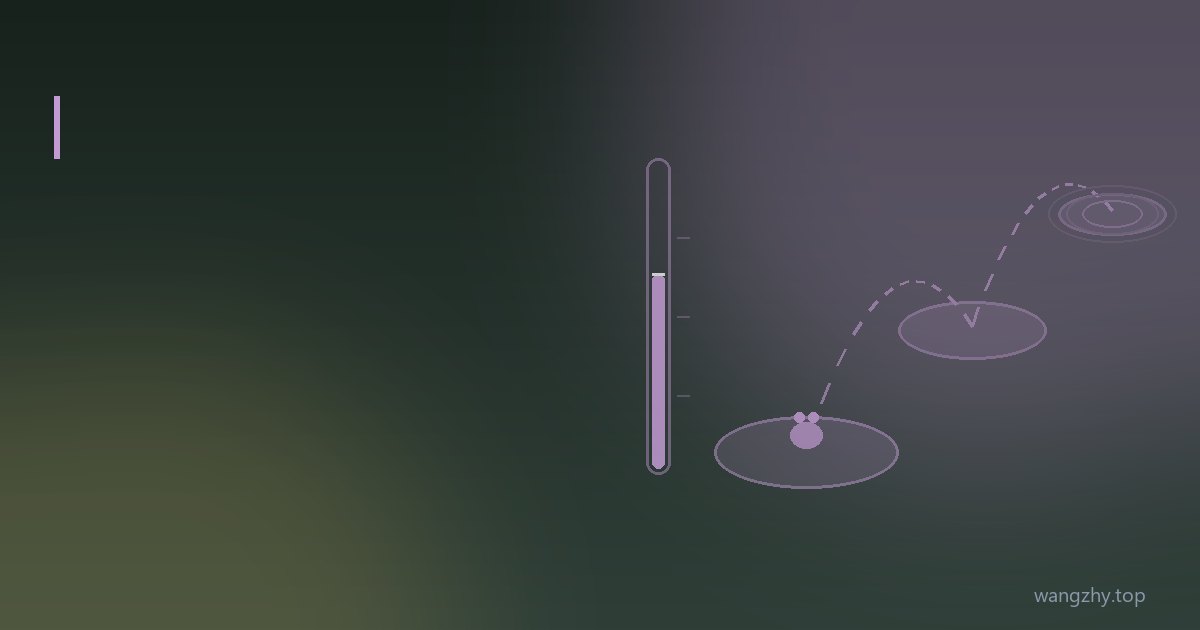
Hold too long and the frog overshoots the lily pad; let go too early and it lands in the water. That narrow “just right” is what quiets a busy head — and it is what most good wind-down games are actually doing: placing the difficulty at the edge of your reach, not inside it.
Pure ease does not actually unwind you
Popping bubble wrap, tapping a wooden fish, watching sand run down a screen — mechanical actions like these do relax people, but with a condition nobody mentions: they only work in short bursts. Past five minutes your hands keep moving while your attention drifts off, and you end up popping bubbles while replaying a work message in your head.
There is an old finding here. In 1908, Yerkes and Dodson described performance against arousal as an inverted U: too little stimulation and you get drowsy and distractible, too much and your hands fumble the task. The comfortable spot is not the peak. It sits above the middle — still under control, but requiring a little effort.
That explains a lot. It explains why lying down with a phone leaves you more tired than before: the stimulation never stops, but none of it asks anything of you, so attention gets yanked away and dragged back, over and over. It also explains why click-only match games make you sleepy after a while, while something that requires judging distance and timing keeps you awake.
Flow is not mystical, it is three conditions
In Flow (1990), Mihaly Csikszentmihalyi broke down the “where did the hour go” state into a handful of conditions. The three that matter most: a clear goal, immediate feedback, and a challenge slightly above your current skill. Get all three and you sink in. Miss one and you are either bored or anxious.
A game like jump-jump happens to hit all three. Clear goal: the next pad is right there in view. Immediate feedback: half a second after you release, you know whether you made it — no waiting for someone to review it. Right difficulty: the gaps change every time, but within a range you can learn in two or three jumps.
Now look at a normal working day, where often none of the three is present. The goal is vague (“just polish this proposal a bit more” — polished to what?). Feedback is delayed by a week. And you do not set the difficulty yourself: it is either so repetitive it numbs you, or so large you cannot find the first step. Stay in that state long enough and you instinctively look for something where you find out immediately whether you got it right. Small games fill exactly that gap.
The half second of charging settles the body first
Press and hold. The power bar creeps up. You watch it and estimate “a bit more and I will overshoot.” What happens in that half second is not thinking — it is proprioception at work: pressure in the fingertip, the rhythm of your breathing, a fixed point for your eyes. All of it collapses into one small place.
A slingshot, a stress ball, a Rubik’s cube — same principle. The muscle pre-tensions, then releases in one go, and the body uses that to discharge some of what has built up. Scrolling, by contrast, is passive intake: your hand never controls force, so there is no release.
That is why, given the same two minutes, a charge-and-release game settles you more than a pure tapping game. It is not the artwork. It is that it asks your body to take part, and once your body is occupied, the loop of circling thoughts has less room to get in.
Falling in the water is fine because it costs nothing
Losing stings slightly, and the sting fades in seconds, because the price is tiny: a round lasts fifteen seconds, nothing is saved, there is no ranking to defend, and one tap starts over. Psychology calls this reversibility — when mistakes can be undone, people explore more and learn faster.
Most failures at work are not reversible. The email went out. The meeting happened. The proposal is already on someone else’s laptop. Because nothing can be taken back, every decision gets weighed several times before it is made, and the weighing itself is exhausting.
A small game is a safe practice field: you can miss five times in a row and nothing follows. That freedom to fail is part of the unwinding — worth more, honestly, than winning a round.
When it stops being rest and becomes an evaluation
The same game turns into something else once you add either of two things: a leaderboard, or a timer. A ranking converts “I managed it” into “I am worse than them.” A countdown converts “take your time” into “you are out of time.” The moment a challenge is used to score you, it becomes an appraisal.
Self-determination theory holds that intrinsic motivation rests on autonomy, competence and connection. A well-sized challenge feeds competence: I put in some effort and I did it. A leaderboard feeds comparison instead, and autonomy gets squeezed out — you start playing to someone else’s pace rather than to how you feel today.
Here is a simple check: after playing, do you feel restored or drained? The first means you just rested. The second means you just worked a shift you did not want. Plenty of people have produced both results with the same game, and the difference is usually whether they were chasing the number.
How to spend two minutes without wasting them
Set a closing condition first: stop when this round ends, not “one more round.” The two sentences sound alike, but they decide whether this is rest or procrastination — one has an endpoint, the other does not.
On the eyes, the widely repeated 20-20-20 rule says: every twenty minutes, look at something twenty feet away for twenty seconds. A two-minute round lands on a natural interval, so looking out the window afterwards beats playing five in a row and rubbing your eyes. We wrote about how to slice these pauses in micro-breaks.
When you get stuck, stop pushing. If your hand has stopped obeying you, that is where your reaction time is today. Switching to something that needs no thought — water, a short walk — works better than ten more attempts.
And do not use it to fill a wait. Playing one round in the three minutes before a meeting means your attention is still parked in that meeting: half-hearted play, and neither side rested. Play two honest minutes, then go back. It is the same trap as short video, and it comes down to attention residue.
If you want to try it, there is jump-jump on this site: hold to charge, release to hop, every gap is different, and falling in ends the round. Fifteen seconds a game, stoppable at any point, and the board only counts pads in one run - one entry per device, no tiers. Play two rounds, then go get some water.
Frequently asked questions
Why do these little games bother leaving in some difficulty?
Because purely mechanical actions only hold you for a few minutes before attention drifts off on its own. A bit of difficulty that needs control and judgement is what pulls hands, eyes and attention onto the same object — that is the "challenge slightly above skill" condition in flow. The difficulty is not there to be beaten. It is there to keep you in the moment.
Calling a game "rest" — is that just self-deception?
Check whether it has an endpoint. A clear ending, stopping when it ends, no chasing numbers: that is real rest. Reloading again and again for a rank turns it into a task without a time clock. Both outcomes happen with the same game; the difference is whether you stop loose or tense.
Does a one-mistake-and-restart game make people more impatient?
It depends on what failure costs. When a round is fifteen seconds, nothing is saved and restarting is one tap, repeated misses actually relax people, because the brain knows the cost is reversible. Add a countdown and a leaderboard and the same failure starts generating pressure. Impatience rarely comes from failing; it comes from failing being scored.
How many minutes a day is reasonable?
Two or three minutes at a time, a few times a day, as a reason to get up for water rather than a place to kill time. Stop at the first sign of dry or aching eyes and look into the distance. Before bed, swap it for something to listen to — a countdown is not helpful when you are trying to fall asleep.